Viser opslag med etiketten Irish. Vis alle opslag

lørdag den 19. marts 2011

Colin Bateman, Mystery Man (2009)


This novel is a Northern Irish stand-alone (a belated St Patrick´s Day review) 

The narrator of this story is a nameless first-person owner of a bookshop in Belfast. When his neighbour, a private detective, disappears, he is more or less pushed into taking over his unsolved cases.

One cannot help admiring the enterprising protagonist who calls himself Lawrence Block:
"The next customer was just looking for directions. He wanted to know where Queen´s University was. I said I wasn´t sure and sold him a street map. It was only around the corner, but the profit was the difference between burger and steak."

The detective business seems to be a bright, new way of making money, and having solved a couple of cases relatively successfully, ´Larry´ feels he is ready to embark on a missing person case. Soon he is not sure if he has got himself entangled in a Nazi conspiracy or just a long row of unfortunate coincidences.

This is an extremely funny story, especially Larry´s fumbling relationship with the girl next door, his self-appointed sidekick who is not always willing to accept her minor role.

I bought it myself and read it for the Ireland Reading Challenge # 4.

See the review that tempted me: Mystery Man

fredag den 18. februar 2011

Declan Burke, The Big O (2007)


This love ... eh caper crime story is the writer´s second novel. No, of course a male Irish writer doesn´t write love stories. Yet... No, certainly not.

"Except what Karen remembered best was his eyes in the split-second when he realised what had just happened. How they got clearer but stayed perfectly still. Tigery eyes, gold flecks in hazel. Karen, knowing he couldn´t see her face behind the helmet´s visor, had been tempted to wink."

So this is the story about Ray and his companions who want to abduct Margaret, Frank´s ex-wife. Or perhaps it is the story about Karen, Frank´s receptionist and Margaret´s friend, who holds up people in her spare time and meets Ray during one of her stick-up ventures. 

And that´s when things begin to get a bit complicated. You are already confused? Honestly, so was I, at least half of the time, but I didn´t mind very much, because this story was just so funny that I didn´t worry too much about who did what to whom.

The book was a gift from a blog friend. I read it for the Ireland reading challenge # 3 and What´s in a Name (size).

fredag den 4. februar 2011

Brian McGilloway, Gallows Lane (2008)


This Irish police procedural is the second in the Inspector Benedict Devlin Series.

This book was a fine choice for the Irish challenge. It conveys a strong sense of the setting close to the border of Northern Ireland and the special working conditions for the police force in a border area. Besides, McGilloway strikes a fine balance between giving too much or too little information about ´the Troubles´ between North and South.

On the very first page James Kerr is released from prison, and Superintendent Costello orders Devlin to keep an eye on him to find out if he really has found Jesus or is bent on revenge. He acted as a driver in a robbery, but his partners shot him and left him in the car for the police to pick him up.

Other elements of the plot are young women who are beaten up, and some drugs which are found in the backyard of British Peter Webb. Apparently Webb reacts by committing suicide, but perhaps things are a bit more complex. Besides, James Kerr seems to be interested in Webb and his wife.

As usual, Ben Devlin and his partner, Caroline Williams, have to get round the Special Branch to try to get some of the answers to their questions. Devlin is a likeable and very human protagonist who loves his family but gets caught up between priorities such as honesty, loyalty to colleagues and his own ambitions.

I bought the book myself, and I am looking forward to the third volume which is already on my shelf.
Read for the Ireland Reading Challenge # 2.
.

mandag den 3. januar 2011

Tana French, The Likeness (2008)


[Dansk titel: Tana French, Som i et spejl - 2009]

This thriller is the Irish writer´s second novel featuring Cassie Maddox. See my review of her debut, In the Woods.

As I have read this one for the Ireland Reading Challenge, I thought the quotation below was very suitable. Besides, the setting (the Georgian Whitethorn House in Wicklow outside Dublin) is fairly important for the story:

“This country´s passion for property is built into the blood, a current as huge and primal as desire. Centuries of being turned out on the roadside at a landlord´s whim, helpless, teach your bones that everything in life hangs on owning your home. This is why house prices are what they are: property developers know they can charge half a million for a one-bedroom dive, if they band together and make sure there´s no other choice the Irish will sell a kidney, work hundred-hour weeks and pay it.”


After her latest murder case, Detective Cassie Maddox was traumatised which is why she has worked for the relatively quiet Domestic Violence section for a couple of years. But in the first chapter of this novel, her boyfriend Sam O´Neill who works for the Murder squad calls her out to take a look at a body. On the scene Cassie sees her own face, and she learns that some young girl has stolen her undercover identity as Lexie Madison. So now the main question is if the murderer wanted to kill the anonymous girl, or if he might have been after Cassie Maddox. In order to smoke out the murderer, Frank Mackey who runs the undercover operations persuades Cassie to assume Lexie´s identity – just for a few weeks.

Cassie had just found some kind of equilibrium with her new colleagues and Sam, but now Frank and Sam pull her in each their direction. Frank is a persuasive detective who obviously loves excitement and challenges whereas the gentle and level-headed Sam tries his best to protect Cassie. And Cassie has to make up her mind whether she prefers her quiet existence or if she wants to live the highly intoxicating life of an undercover agent again. And then there are Lexie´s four, young friends whom she lived together with in Whitethorn House.

Though I must agree with reviewers who have pointed out that the story is long-winded (the paper back is 700 pages), I was completely absorbed by the haunting atmosphere and the compelling characters. I just had to know what happened to them.

I bought the book myself. Read for Ireland Reading Challenge # 1.
.

fredag den 1. oktober 2010

Brian McGilloway, Borderlands (2007)


I had a feeling that the Irish Inspector Devlin series would be exactly my taste so when a friend gave me the third book, I bought this debut plus the second volume myself so I could read them in order. 

Already in the first paragraph, we get a strong sense of the setting peculiar to this story:

“It was not beyond reason that Angela Cashell´s final resting place should straddle the border. Presumably, neither those who dumped her corpse, nor, indeed, those who had created the border between the North and South of Ireland in 1920, could understand the vagaries that meant that her body lay half in one country and half in another, in an area known as the borderlands.”

As the border is relatively new, the local population cross the arbitrary border all the time to work, meet friends and commit crimes, and the local police on both sides try to make the best of it by cooperating. Not necessarily flawlessly, but less dramatic and conflict-ridden than a few years earlier.

The story offers a fine mystery; why would anyone kill a sixteen-year-old girl and leave her almost naked, but with a valuable ring on her finger? More deaths take place before Ben Devlin and his colleagues can pin down the murderer, and at some point they realize they have to go back to another case twenty-five years ago when a woman went missing, a case one of their own superiors may have been involved in.

A well-written debut of high quality and lots of suspense. Furthermore, the characters are well-drawn and interesting, especially Ben Devlin who seems to be a good family father and a competent investigator though his flaws, e.g. his nasty temper, make him very human indeed.

torsdag den 8. juli 2010

Rob Kitchin, The White Gallows (2010)


This Irish police procedural is the second in the Colm McEvoy series.

Within one day Detective Superintendent Colm McEvoy is sent out to two deaths. The first one is an anonymous Lithuanian, the second is old Dr Koch, a German billionaire in his 90s, the founder of a successful company. At first glance, Koch seems to have died a natural death, but the young officer who arrives at the crime scene suspects foul play when he notices some marks on the body.

Outside Koch´s unassuming farmhouse the police discover a noose hanging from an old oak tree. A gallows, prepared for Dr Koch, or some kind of message? Significantly, the noose is placed where the local gallows was in the past (nice touch), indicating that Koch´s death may be related to his past.

The hotheaded relatives are less than pleased when they realize they are on McEvoy´s list of suspects together with his Polish housekeeper Roza, his temperamental neighbour and two East Europeans, members of the Jewish organization the Yellow Star. The organization is on the track of a Nazi war criminal who used his expertise on chemistry in the Jewish Skeleton Project, a most horrible concentration camp experiment.

Colm McEvoy, a likeable and honest detective, has been a single father since his wife died of cancer a year ago. His twelve-year-old daughter seems to cope well and be happy to spend much of her time with her aunt though she can´t help worrying whether her hard-working father remembers to eat. McEvoy misses his wife acutely, and as he quit smoking a few months ago he is not only lonely and overworked, but also highly irritable. As a consequence, McEvoy rubs several people up the wrong way, suspects as well as colleagues, yet it may be a sign that he is ready to move on with his life that he shows some interest in Kelly Stringer, his pretty colleague with the shapely legs.

It was a great pleasure to read my way through the twists and turns of this exciting, yet quite realistic novel which is a highly appreciated gift from the writer. See my review of Rob´s debut, The Rule Book.

And to quote Norman of Crime Scraps, "Hopefully there will be a book three in the series."

onsdag den 7. juli 2010

Straight from the reader´s mouth

As I am cameraless today, I can´t show you my husband´s bargain. A clue: it is Swedish, and something you can read.

And finally I have read a book! No reviews for eight days, what a pathetic book blog. There will be a review for you tomorrow, though.

For now, a teaser:

“The farmhouse was a two-storey structure covered in Boston Ivy that had recently lost its bright red leaves. Three steps led up to a Georgian door, a semi-circle of clear glass above it. There were two Georgian sash windows to the left of the door, one to the right. A single-storey structure continued past the house to the right, interrupted along its length by a high archway. From McEvoy´s experience it almost certainly led into a farmyard that would be framed all the way round by outbuildings. It was a modest house for someone reputed to be one of the richest men in Ireland.”

I don´t know about you, but this farmhouse and its history is a setting I like. And on page 304 - oh, no, I shouldn´t tell you this, but I also like when the clues and tracks are a bit out of the ordinary. Nice touch!

And tomorrow I am going to take you to Ireland, one of my favourite holiday resorts.

tirsdag den 11. maj 2010

Irish crime


Is there anything better than receiving a signed copy of a book you really want?


Yes, apparently.

Look here: a signed copy of The White Gallows
PLUS a quotation from my review of
Rob´s crime fiction debut, The Rule Book.

Rob, you really made my day!

lørdag den 27. marts 2010

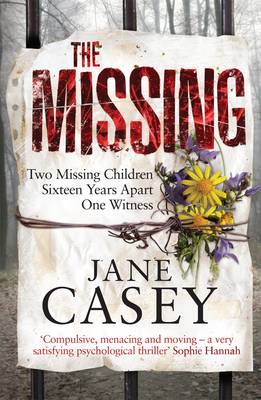
Jane Casey, The Missing (2010)


This thriller is the British writer´s debut.

The main character, Sarah Finch, lost her older brother when she was eight years old. Charlie walked away from home one afternoon and never came back so her parents, especially her mother, have not been able to get on with their lives.

Many years later, when Sarah works as a teacher, one of her twelve-year-old students goes missing, and Sarah finds her body during her jogging round. Soon she is deeply involved in the mystery, initially because she identifies with the poor parents in their terrible loss, but probably also because her own life as a teacher, cooped up with an alcoholic mother, is not nearly as interesting as investigating crimes. And of course she learns that if you meddle in crime, you will soon be exposed to all sorts of hardship and danger.

The plot is exciting all the way through, and on the whole the characters are interesting, but it seems as if Sarah Finch is not described quite consistently. Sometimes she seems strong and independent, at other points it is difficult to decide if the mother needs Sarah or Sarah needs her mother. My overall impression is that Casey has written a convincing and impressive debut, however, and I am going to watch out for more books from her hand.

The book was sent to me by my book fairy, Maxine.

mandag den 5. oktober 2009

Martin McDonagh, The Beauty Queen of Leenane (1996)


[Denne bog er ikke oversat til dansk]

This Irish work is not traditional crime, but drama. The reason why I have decided to write a short review is that this story about an old, ailing mother and her fortyish daughter is an excellent psychological thriller.

The whole drama takes place in a rural cottage in County Galway, and the best way to give you an impression of the main characters is probably through a somewhat long quotation:

Mag: I do be scared, Maureen. I be scared what if me hand shook and I was to pour it over me hand. And with you at Mary Pender´s, then where would I be?

Maureen: You´re just a hypochondriac is what you are.

Mag: I´d be lying on the floor and I´m not a hypochondriac.


Maureen: You are too and everybody knows that you are. Full well.


Mag: Don´t I have a urine infection if I´m such a hypochondriac?


Maureen: I can´t see how a urine infection prevents you pouring a mug of Complan or tidying up the house a bit when I´m away. It wouldn´t kill you.


Mag: (
pause) Me bad back.

Maureen: Your bad back.


Mag: And me bad hand. (
Mag holds up her shriveled hand for a second.)

Maureen: (
quietly) Feck … (Irritated.) I´ll get your Complan so if it´s such a big job! From now and ´till doomsday! The one thing I ask you to do. Do you see Annette or Margo coming pouring your Complan or buying your oul cod in butter sauce for the week?

Mag: No.


Maureen: No is right, you don´t. And carrying it up that hill. And still I´m not appreciated.


Mag: You
are appreciated, Maureen.

Maureen: I´m not appreciated.


Mag: I´ll give me Complan another go so, and give it a good stir for meself.


Maureen: Ah, forget your Complan. I´m expected to do everything else, I suppose that one on top of it won´t hurt. Just a … just a blessed fecking skivvy is all I´m thought of!


Mag: You´re not, Maureen.


Maureen slams a couple of cupboard doors after finishing with the shopping and sits at the table, after dragging its chair back loudly. Pause.


Mag: Me porridge, Maureen, I haven´t had, will you be getting? No, in a minute, Maureen, have a rest for yourself …


Even my 18-19-year-old students loved this, and several of them admitted that they had been reading ahead! A horrible story about the relationship between mother and daughter, with a strong element of pitch-dark, Irish humour.

søndag den 9. august 2009

Rob Kitchin, The Rule Book (2009)


[Denne krimi er desværre ikke oversat til dansk]

This Irish police procedural is the author´s first work of fiction.

The first paragraph:
“His eyes fixed on the sword and started to travel its length, down from the black handle, over the plain hilt and along the two-inch wide shaft to where it penetrated the young woman´s mouth. Beneath her head the pillow and sheet were stained a mix of red and black.”

A young woman is brutally killed, and the murderer has left what seems to be the first chapter of a rule book for serial killers in her shoulder-bag.

The arrogant murderer who calls himself “the Raven” continues to kill one person every day, leaving his calling card and a new chapter of his rule book on the scene of crime, but no other traces. He is convinced that the serial killer who adheres to these rules is invincible, and this game with rules (broken as well as unbroken) forms an important part of the intriguing web Rob Kitchin has spun around the reader.

Soon Detective Superintendent Colm McEvoy is so absorbed in this case that he forgets to eat and sleep. He is a single father who lost his wife to cancer recently and now he struggles to give up her killer, the cigarettes, and to be there for his eleven-year-old daughter, Gemma (while she does her best to take on her mother´s role).

For this flu-ridden reader it took a few pages to get into the story, as there are quite a lot of DIs and DSs to relate to in this complex mystery. It was certainly worthwhile, however, and after the first day I was entangled in the web and forgot all about my headache and my runny nose. In the beginning I feared that the combination of serial killer plus male writer might turn into a hard-boiled, graphic story, but in the best traditions of British crime fiction the focus stays with the police work and the increasingly personal battle between McEvoy and the killer.

And Colm McEvoy - the very human but frustrated copper and father - is one of those characters you really want to meet again – the sooner the better!

tirsdag den 24. marts 2009

Tana French, Skoven (2008)

Irsk thriller-debut, 2009 reading challenge: ´murder mystery´.
Mange år før plottet i denne thriller udspiller sig, forsvandt tre irske teenagers fra deres hjemby uden for Dublin. Kun Adam bliver fundet igen, blodig og chokeret, og ude af stand til at huske, hvad der er sket.

Tyve år senere er Adam tilbage i Knocknaree-området som kriminalbetjent, nu under navnet Rob Ryan, og sammen med sin makker og nære ven, Cassie Maddox, bliver han sat på en sag om en teenagepige som er fundet myrdet på en mystisk, gammel offersten nogle få hundrede meter fra Robs barndomshjem.

Tana French har skrevet en spændende thriller med et fint plot, og det viser sig naturligvis, at Robs barndomsoplevelser får en vis betydning. Personerne er også fyldigt beskrevet, og bestemt ikke flade og kedelige. Og man kan næppe bebrejde French, at hun har skabt en noget irriterende og utroværdig, mandlig hovedperson. Til trods for sit barndomstraume fungerer Rob tilsyneladende som kriminalbetjent, som makker og i forhold til kvinder, men som han selv indleder med at forklare læseren, så skal man måske ikke stole alt for meget på, hvad han siger: ”Jeg vil råde dig til ikke at glemme, at jeg er kriminalassistent. Vores forhold til sandheden er i bund og grund fuldt af sprækker …”

Så nyd en flot og lovende debut af en forfatter, jeg bestemt gerne vil høre mere fra, også for hendes glimrende miljøbeskrivelse, men lad være med at tage alt for meget af det du får fortalt for pålydende.

Tana French, In the Woods (2007)
Irish debut, part of my 2009 Suspence and thriller reading challenge: murder mystery.
Many years before the real beginning of this plot, three Irish teenagers disappeared from their hometown outside Dublin. Only Adam reappears, bloody and in shock, unable to remember anything about what has happened.

Twenty years on, Adam Ryan is back in the Knocknaree area as a police detective, now under his middle name Rob, and together with his colleague and best friend, Cassie Maddox, he gets a case about a teenage girl who is found murdered on a mysterious, old sacrificial alter a few hundred metres from Rob´s childhood home.

Tana French has written an exciting thriller with a fine plot, and of course Rob´s childhood experiences are of a certain importance.. The characters are described in great detail and not at all flat or boring. And one can hardly blame French that she has created a somewhat annoying and incredible, male character. In spite of his childhood trauma Rob seems to function in his capacity as detective, as a partner and in his various relationships with women, but as he begins by telling the reader, one is not supposed to trust what he says, “What I warn you to remember is that I am a detective. Our relationship with truth is fundamental but cracked …”

So enjoy a fine and promising debut by an author I should like to hear more from, also for her interesting descriptions of the Irish environment, but remember: do not trust too much of what her characters tell you!